Industrial Curtain Material Guide: PVC Thickness, Weight & Fire Ratings Explained
When you’re comparing curtain wall quotes from different manufacturers, you’ll see specs like “15.1 oz/yard^2” and “NFPA 701” and “mil thickness.” These numbers matter enormously—but what do they actually mean?
Understanding material specs is the difference between buying a curtain that lasts 3 years and one that lasts 10.
As a manufacturer with 13+ years of PVC curtain production, we’ve learned that most buyers don’t understand material terminology. They buy by price, then get surprised when durability falls short. This guide cuts through the confusion.
What PVC Curtain Walls Are Made Of
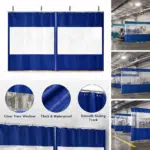
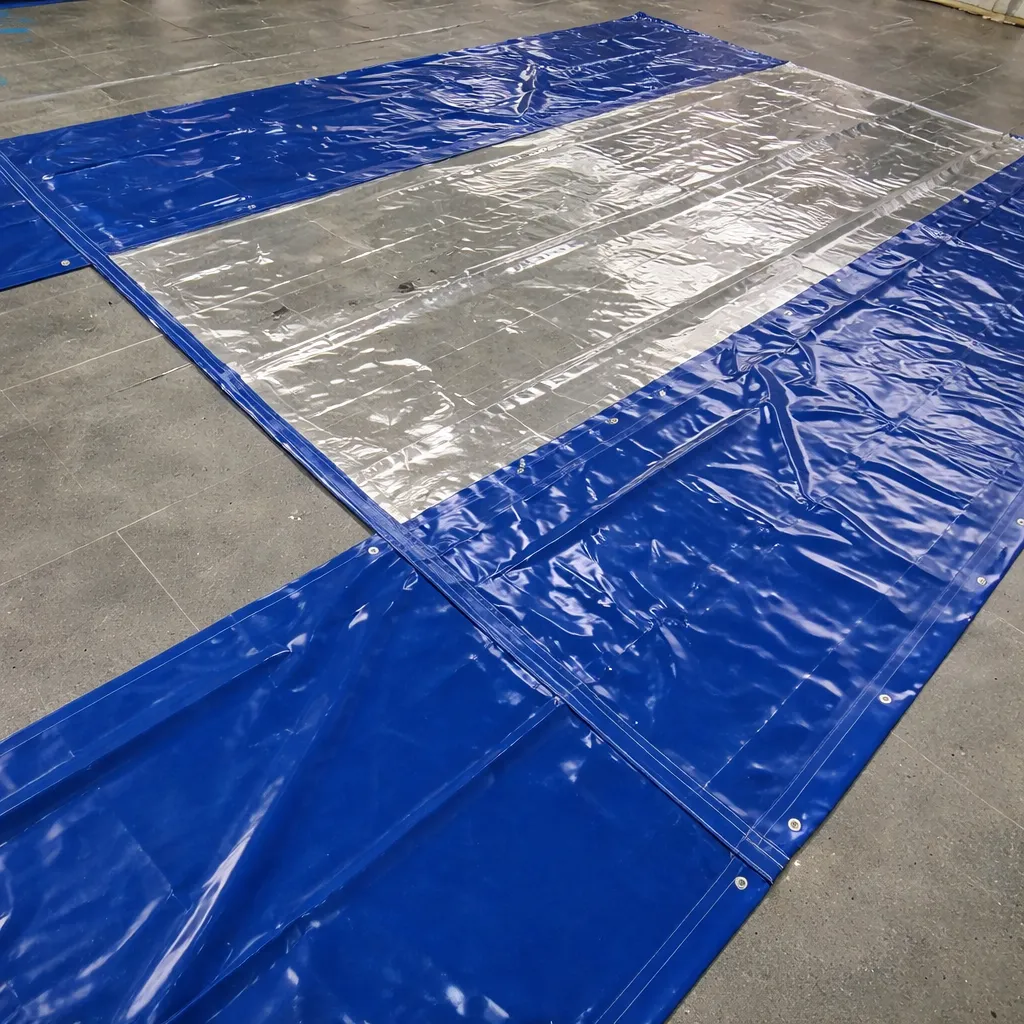
First, clarify what you’re buying. Industrial PVC curtain walls are not solid plastic.
Actual structure:
- Base fabric: Polyester (woven or knitted)—provides tensile strength
- PVC coating: Vinyl polymer—bonds to fabric, provides waterproofing and UV protection
- Additives: Fire retardants, UV stabilizers, plasticizers (make PVC flexible)
The base fabric provides structure; the PVC coating provides durability and weather resistance. Neither alone is functional.
Why this matters: Two curtains can be “PVC coated” but have vastly different durability if one has 2 layers of coating and the other has 1. Cheaper curtains save money by reducing coating thickness.
Thickness Explained: Mil, MM, and Why It Matters
“How thick is your PVC curtain?” is the most common question—and the most misunderstood.
Measurement Units:
Mil = 1/1000 of an inch
- Common in North America
- Example: “20 mil” = 0.020 inches
- Typical industrial range: 15–30 mil
MM = millimeters
- Common in Europe and Asia
- Example: “0.5 mm” = 0.020 inches (same as 20 mil)
- Typical industrial range: 0.4–0.8 mm
Conversion: 1 mm ≈ 39.4 mil
What Thickness Actually Controls:
Durability: Thicker = longer lifespan
- 15 mil PVC: 3–4 years typical (light industrial)
- 20 mil PVC: 5–6 years typical (general industrial)
- 25 mil PVC: 7–8 years typical (heavy-duty)
- 30+ mil PVC: 10+ years typical (extreme environments)
Flexibility: Thinner = more flexible
- Thin curtains (15 mil) slide smoothly and fold easily
- Thick curtains (30 mil) are stiffer, require stronger track systems
Cost relationship:
- Each additional mil of thickness adds ~5–10% to material cost
- Going from 20 mil to 25 mil might add 25–50% to cost (because of manufacturing complexity)
Impact resistance: Thicker curtains resist puncture and tear better
- 15–20 mil: Vulnerable to sharp edges, aggressive handling
- 25–30 mil: Resists abuse, can handle warehouse or welding environment
SKP Material Thickness Options:
[FACTORY SPEC: SKP Material thickness options in mil and mm, and corresponding durability recommendations by application]
For reference, typical industrial thickness ranges:
- Light-duty: 15–18 mil
- Standard: 18–22 mil
- Heavy-duty: 22–26 mil
- Extreme: 26–30+ mil
Weight Explained: Understanding oz/yard^2 and gsm
Weight is another critical spec that confuses buyers.
Measurement Units:
oz/yard^2 = ounces per square yard
- Weight of finished, coated fabric per square meter
- Includes base fabric + all coatings
- Typical range: 13.4–25.1 oz/yard^2
gsm = grams per square meter
- Metric equivalent
- 1 oz/yard^2 ≈ 33.91gsm
- Typical range: 450–850gsm
What weight means: More coating + heavier base fabric = more durable, more expensive
Weight-to-Durability Mapping:
13.4–15.1 oz/yard^2 (450–510gsm):
- Type: Standard-grade PVC
- Durability: 3–5 years
- Best for: Temporary partitions, low-traffic areas, light water exposure
- Cost position: $
16.7–18.4 oz/yard^2 (560–620gsm):
- Type: Medium-duty PVC
- Durability: 5–7 years
- Best for: Car wash, wash bays, warehouse, general industrial
- Cost position: $$
- Most popular for industrial use
20.1–21.7 oz/yard^2 (680–740gsm):
- Type: Heavy-duty PVC
- Durability: 7–9 years
- Best for: Welding bays, extreme chemical exposure, high-traffic areas
- Cost position: $$–$$$
23.4–25.1+ oz/yard^2 (800+ gsm):
- Type: Marine/extreme-duty PVC
- Durability: 10+ years
- Best for: Continuous outdoor exposure, corrosive environments, critical containment
- Cost position: $$$–$$$$
Weight vs. Thickness: Which Matters More?
People often ask: “Is heavier better, or is thicker better?”
Both matter, but differently:
- Thickness: Determines PVC coating quality and UV/water resistance
- Weight: Reflects total material (base fabric + coating); indicates durability and longevity
Example comparison:
- Material A: 20 mil thickness, 15.1 oz/yard^2 = thin coating on lightweight fabric (reasonable, but moderate durability)
- Material B: 18 mil thickness, 20.1 oz/yard^2 = thinner coating on heavy base fabric (good durability, good flexibility)
For most industrial applications, 18.4 oz/yard^2 with 20–22 mil thickness is the sweet spot—good durability, reasonable cost, easy handling.
Fire Ratings Explained
Fire ratings confuse buyers because there are so many different standards.
NFPA 701: Small-Scale Flame Propagation Test
What it tests:
- How quickly a flame spreads across the material surface
- How much smoke is produced
- Whether the flame self-extinguishes
Test process:
- Small sample (6″ × 12″) suspended vertically
- Flame applied to bottom edge
- Measured for flame spread distance and time to self-extinguish
Results:
- Pass (NFPA 701 compliant): Flame doesn’t spread more than 6.5 inches; no flaming drips; self-extinguishes in <60 seconds
- Fail: Flames spread >6.5 inches or fail to self-extinguish
What it means: Material won’t spread fire rapidly. Used in most building codes for interior partitions.
Cost to material: Fire retardant additives add 15–30% to material cost.
ASTM E84: Large-Scale Flame Spread Test
What it tests:
- Flame spread characteristics on a larger sample (8′ × 2′)
- Smoke development
- Results compared to reference materials (fiberglass = 0, oak = 100)
Test process:
- Sample mounted horizontally in a 25-foot tunnel
- Gas flame applied to one end
- Measurement of how far flame travels in 10 minutes
- Smoke volume measured
Results:
- Class A: Flame spread index 0–25 (best)
- Class B: Flame spread index 26–75 (good)
- Class C: Flame spread index 76–200 (acceptable)
What it means: More rigorous than NFPA 701. Class A is required by many state building codes and insurance companies.
EN71-3 & SGS Testing: What SKP Has
You might see SKP certificates for “EN71-3” and “SGS testing.” Here’s what these mean:
EN71-3: Tests for heavy metal content (lead, cadmium, etc.) in materials that contact children or food
- What it tests: Not fire rating—safety from toxic materials
- Relevance to curtains: Not directly applicable to industrial curtain walls
- Why we have it: Demonstrates manufacturing quality control and material safety standards
SGS Testing: Third-party laboratory verification of material properties
- What it does: Verifies claimed specs (thickness, weight, coating integrity)
- Relevance: Proves material meets stated specifications
- Why we have it: Quality assurance and buyer confidence
Important: EN71-3 and SGS do NOT certify fire ratings. They certify material quality and safety, not flammability.
NFPA 701 vs. ASTM E84: Which Do You Need?
| Scenario | Required Standard |
|---|---|
| Indoor warehouse (non-critical) | Often not required (check local code) |
| California indoor facility | NFPA 701 or ASTM E84 typical |
| Building code compliance required | NFPA 701 typical |
| Insurance requirement | Often ASTM E84 Class A |
| Welding bay or high-risk area | NFPA 701 + fire retardant strongly recommended |
Bottom line: Regulatory requirements vary by location. Always check your local fire code or ask your insurance provider what’s required.
CFM (California Fire Marshal) Standards
California has state-specific fire ratings:
- Title 24: California Building Code requirements
- CFM Listing: Materials on the CFM’s approved list for interior finishes
- Flame Spread Index: California often requires 0–75 (stricter than federal ASTM E84)
If you’re operating in California, verify CFM compliance with your supplier.
How to Choose Material Grade for Your Application
Use this decision table to select the right material:
| Application | Recommended Grade | Why | Cost Position |
|---|---|---|---|
| Warehouse division (low-traffic) | 16.7 oz/yard^2, 18–20 mil, standard PVC | Adequate durability, cost-effective | $ |
| Car wash / Wash bay | 18.4 oz/yard^2, 20–22 mil, water-resistant | High moisture, moderate durability need | $$ |
| Welding bay | 20.1–21.7 oz/yard^2, 22–24 mil, fire-retardant | Heat resistance + fire rating required | $$–$$$ |
| Chemical/aggressive environment | 21.7–23.4 oz/yard^2, 24 mil, fire-retardant + additives | Maximum durability + chemical resistance | $$$–$$$$ |
| Outdoor/temporary | 18.4 oz/yard^2, 20 mil, UV-stabilized | UV exposure requires protection | $$ |
| Temporary partition (low cost) | 15.1 oz/yard^2, 15–18 mil, standard | Short lifespan acceptable | $ |
Manufacturer Insight: How PVC Coating Actually Works
Understanding the manufacturing process clarifies why specs matter:
The Coating Process:
- Base fabric preparation: Polyester fabric is inspected and measured
- First coating pass: PVC compound is applied to one side of the fabric by:
- Knife-over-roll (thickness control), or
- Extrusion (uniform coating)
- Additives: During coating, fire retardants, UV stabilizers, and plasticizers are mixed in:
- Fire retardants (Halogenated compounds or phosphorus-based): Reduce flammability
- UV stabilizers (Carbon black or hindered amine light stabilizers): Protect PVC from sun degradation
- Plasticizers (DEHP, TPE, or replacements): Keep PVC flexible (without these, PVC is brittle)
- Second coating pass: Second side is coated (optional for budget materials, standard for quality curtains)
- Cooling & curing: Material is cooled in water baths, then dried
- Quality check: Thickness verified with gauges, samples tested for:
- Tensile strength
- Tear resistance
- Coating adhesion
- Fire rating (if claimed)
Why this matters for curtains:
- Single-coat vs. double-coat: Double-coat is more durable. Some budget manufacturers use single coat to save cost. Ask your supplier.
- Additive package: Fire-retardant curtains cost more because flame-suppressing chemicals are added during coating. You can’t apply fire rating after manufacturing.
- Uniformity: Quality manufacturers use extrusion; budget manufacturers use knife-over-roll (less uniform thickness).
Common Material Mistakes
Mistake 1: Confusing “Weather-Resistant” with “Fire-Rated”
What happens: Buyer purchases “weather-resistant” PVC for a welding bay, then fails code inspection. Fix: Fire ratings are separate from water resistance. Specify fire retardant if required.
Mistake 2: Assuming Thicker = Always Better
What happens: Buyer chooses 30 mil heavy curtain for a car wash, finds it hard to slide, overstresses track system. Fix: Match thickness to application. Thicker isn’t better if it makes the system difficult to use.
Mistake 3: Buying “PVC Coated” Without Checking Thickness
What happens: Two suppliers both say “PVC coated,” but one is 15 mil (budget) and one is 22 mil (quality). Buyer picks price, gets 3-year lifespan instead of 7. Fix: Always get thickness and weight specs, not just “PVC coated” claims.
Mistake 4: Not Accounting for Climate
What happens: Buyer chooses standard PVC for an outdoor California warehouse. Material degrades in 2 years under UV exposure. Fix: Outdoor use requires UV-stabilized additive package. Specify this upfront.
Material Decision Worksheet
Before requesting a quote, fill this out:
- [ ] Application: ________________________ (car wash / warehouse / welding / other)
- [ ] Water exposure: None / Occasional / Frequent / Continuous
- [ ] Heat exposure: None / Moderate / High (e.g., welding bay)
- [ ] Chemical exposure: None / Mild / Aggressive
- [ ] Fire rating required: Yes / No / Unsure (check local code)
- [ ] Expected lifespan: 3–5 years / 5–7 years / 7+ years
- [ ] Budget priority: Lowest cost / Best value / Maximum durability
Then ask your supplier:
- What weight (gsm or oz/yard^2) and thickness (mil) do you recommend?
- Is this double-coated?
- Does this meet [NFPA 701 / ASTM E84 / your local requirement]?
- What’s the expected lifespan in my specific environment?
FAQ
Q: Can I use outdoor PVC curtains indoors, or vice versa? A: Outdoor PVC (heavy UV protection) can be used indoors—it’s just more expensive than necessary. Indoor PVC (less UV protection) will degrade rapidly outdoors (1–2 years).
Q: Do thicker materials block sound better? A: Marginally. Sound isolation depends on mass and damping, not just thickness. For serious sound blocking, you need drywall or other baffling systems.
Q: How do I know if fire-retardant PVC is really fire-rated? A: Ask for a current test report from a third-party lab (NFPA, ASTM, or equivalent). Legitimate manufacturers have documentation; budget manufacturers may not.
Q: Does PVC material yellow or degrade over time? A: Yes, eventually. Sunlight causes yellowing (1–3 years); UV-stabilized materials yellow more slowly. This is cosmetic, not functional failure.
Q: Can old PVC curtains be recycled or repurposed? A: Yes. End-of-life PVC curtains can be recycled as PVC compound for non-critical applications. Check with local plastic recyclers.
Ready to Specify Your Material?
Now that you understand the specs, you can make an informed choice. Send us your application details, and we’ll recommend the right material grade with transparent cost and durability expectations.
Request a Quote with Material Recommendations →
Have questions about your specific material needs? Our engineering team can help you navigate fire ratings, durability, and cost trade-offs.
Related Reading
- Industrial PVC Curtains: Materials & Specifications
- Industrial Curtain Fire Ratings: NFPA 701 vs ASTM E84
- Industrial Curtain Wall Cost: 7 Factors & Budget Guide
- SKP Material Certifications & Quality Assurance
Ready to get started? Request a Custom Quote or Browse Our Curtain Products on Alibaba.
Author: SKP Material Engineering Team Published: April 2026 Topics: Industrial Materials, PVC Specifications, Durability & Maintenance