Industrial Curtain Fire Ratings Explained: NFPA 701 vs ASTM E84 vs CFM
When you’re building or updating a curtain wall enclosure, fire rating questions come up:
“Does this need NFPA 701?” “What’s ASTM E84?” “Is my state require fire-rated curtains?”
The confusion is understandable. There are multiple standards, they test different things, and requirements vary by location. Add in misleading marketing from suppliers (“flame resistant,” “fire rated,” “non-flammable” with no specs), and buyers end up purchasing the wrong material.
Here’s what you actually need to know about fire ratings for industrial curtain walls.
Why Fire Ratings Matter
Industrial curtain walls are barriers. If a fire starts, you want those barriers to:
- Not spread fire rapidly (flame spread)
- Not produce excessive smoke (smoke development)
- Provide time for evacuation (self-extinguishing)
Building codes and insurance companies require material specs because unrated plastic can act as fuel, spreading fire quickly.
Fire ratings exist to quantify material behavior during fire exposure.
NFPA 701: Small-Scale Flame Propagation Test
What it tests:
- How quickly flames spread across a fabric sample
- Whether the material self-extinguishes
- Specific measurements: flame spread distance and time to self-extinguish
Test procedure:
- Small fabric sample (approximately 6″ × 12″)
- Suspended vertically in a test chamber
- Bunsen burner flame applied to bottom edge
- Measurements recorded:
- Distance flame travels up the sample
- Time for flame to self-extinguish
- Whether flaming drips occur (fail if drips ignite cotton below)
Pass Criteria:
- Flame doesn’t travel more than 6.5 inches from ignition point
- Material self-extinguishes (flame stops) within 60 seconds
- No flaming drips that ignite cotton placed below sample
Results:
- Pass: Material meets NFPA 701 (suitable for building interiors)
- Fail: Material does not meet standard
What it doesn’t test:
- Smoke production (measured but not specified in pass/fail)
- Large-area fire behavior (small sample only)
- Thermal properties (how much heat material produces)
Cost: Adding NFPA 701-compliant fire retardant to PVC material adds 15–30% to material cost.
Common usage: Building codes often reference NFPA 701 for interior partitions, wall coverings, and upholstered materials.
ASTM E84: Large-Scale Flame Spread Test
What it tests:
- How fast flames spread across a larger material sample under controlled conditions
- Smoke production
- Results compared to reference materials
Test procedure:
- Large fabric sample (8 ft × 2 ft) mounted horizontally
- Sample in a 25-foot tunnel
- Gas burner flame applied to one end
- Measurement of:
- How far flame travels in 10 minutes
- Amount of smoke produced
- Results compared to reference materials:
- Fiberglass (0—lowest flame spread)
- Oak wood (100—standard reference)
Results (Flame Spread Index):
- Class A: 0–25 (best—minimal flame spread)
- Class B: 26–75 (good—moderate flame spread)
- Class C: 76–200 (acceptable—significant flame spread)
Smoke Development Index:
- Measured separately (0–450 scale)
- Lower is better
- Many codes limit smoke to 450 maximum
What it doesn’t test:
- Flaming drips (covered in NFPA 701)
- Structural integrity during fire
Cost: ASTM E84 testing costs $$ per sample. Adding fire-retardant material costs similar to NFPA 701 (15–30% material cost increase).
Common usage: State building codes (especially Class A required), insurance underwriting, commercial facility requirements.
Comparing NFPA 701 vs. ASTM E84
| Aspect | NFPA 701 | ASTM E84 |
|---|---|---|
| Sample size | Small (6″ × 12″) | Large (8′ × 2′) |
| Test setup | Vertical sample, flame from bottom | Horizontal sample, flame from end |
| Duration | Until self-extinguish or 60 seconds | 10 minutes |
| Results | Pass/Fail | Flame Spread Index (0–200 scale) |
| Rigor | Less rigorous (smaller sample) | More rigorous (larger, longer duration) |
| Cost to implement | Lower (less testing cost) | Higher (more expensive test) |
| Industry use | General building codes | State codes, insurance requirements |
| Which is stricter? | Less strict; easier to pass | More strict; harder to pass |
Bottom line: ASTM E84 Class A is more rigorous than NFPA 701 Pass. If a material passes ASTM E84 Class A, it will almost certainly pass NFPA 701.
CFM (California Fire Marshal) Standards
California has state-specific fire code requirements (stricter than federal NFPA/ASTM standards).
Title 24 (California Building Code):
- Specifies fire ratings for interior finishes in commercial buildings
- Flame Spread Index requirements: typically 0–75 (stricter than ASTM E84 Class B)
CFM Acceptance:
- Materials must be tested and listed on the CFM’s “Accepted Materials List”
- If your product isn’t on the list, it’s not approved for use in California
- Testing must be done by a state-approved lab
California-specific requirements:
- Many commercial applications require Flame Spread Index 0–25 (Class A equivalent)
- Some applications allow 0–75 (Class B-like)
- Smoke development limits often apply (≤450)
Why it matters: If you’re operating a wash bay or warehouse in California, verify with your local fire marshal whether fire-rated materials are required and what CFM acceptance means.
SKP Material’s Current Certifications
SKP Material (our company) currently holds:
What We Have:
- EN71-3 certification (heavy metal safety—tests for lead, cadmium in materials)
- SGS testing (third-party verification that material meets stated specifications: thickness, weight, coating integrity)
- Japan Fire Retardant Standard compliance (for markets requiring it)
What We Don’t Have (Yet):
- NFPA 701 certification (not yet conducted; can be added)
- ASTM E84 certification (not yet conducted; can be added)
- CFM listing (not yet; requires ASTM E84 + CFM acceptance process)
What This Means:
- Our standard PVC curtains are NOT fire-rated
- Our fire-retardant PVC material is formulated for fire resistance, but we don’t have third-party test certification
- If you need certified fire-rated curtains, we can arrange testing or provide fire-retardant material with a path to certification
How to Specify Fire-Rated Curtains
If your project requires fire-rated material, here’s how to specify:
Step 1: Determine Your Requirement
Ask your:
- Local building inspector: “What fire rating do I need for a [warehouse/car wash/welding bay] partition?”
- Insurance agent: “Do you require fire-rated barriers for coverage?”
- Fire marshal: Confirm specific standard (NFPA 701, ASTM E84, CFM, or state-specific)
Step 2: Request Fire-Rated Material from Supplier
When contacting a supplier (including SKP), ask:
- “Do you offer fire-retardant PVC material?”
- “Can you provide an NFPA 701 test report or ASTM E84 certification?”
- “What’s the fire rating class (Class A, B, C)?”
- “Is this material CFM-listed?” (if California)
Step 3: Verify Documentation
Request:
- Current test report from a recognized third-party lab (not supplier self-testing)
- Test date and expiration (certifications typically valid 5 years)
- Lab accreditation (typically NRTL—Nationally Recognized Testing Lab)
- Material specification matching your project (thickness, weight, color, etc.)
Red Flags:
- “It’s fire-resistant” without specs (vague, not certification)
- “We use fire-retardant additives” without test report (unverified)
- “It won’t burn” (no material is non-flammable; all plastics burn)
- Test report with no date (could be expired)
- “Flame retardant per [standard]” without actual report (unverified claim)
Fire-Rated vs. Standard PVC: Cost & Lifespan
Standard PVC Curtains
- Cost: $$ (baseline)
- Fire behavior: Will ignite and spread flame
- Suitable for: Non-critical areas, outdoor use, rented spaces
- Lifespan: 5–8 years
Fire-Retardant PVC Curtains
- Cost: $$–$$$ (15–30% more than standard)
- Fire behavior: Resists ignition; self-extinguishes if exposed to flame
- Suitable for: Enclosed bays, facilities with code requirements, insurance-required
- Lifespan: 5–8 years (same as standard; fire retardant is additive, not structural)
- Maintenance: Same as standard PVC
ROI of fire-rated material:
- If your code requires it: ROI = 100% (compliance is mandatory)
- If optional: Cost $$ to $$$. Fire risk is low in most industrial settings (unless welding, chemical exposure, or high-traffic)
- Insurance discount: Some insurers reduce premiums if fire-rated materials are used; ask your agent
FAQ
Q: What’s the difference between “fire-resistant,” “flame-resistant,” and “fire-rated”? A: These terms are often used interchangeably but have different meanings:
- Fire-resistant: Slows fire spread (vague, marketing term)
- Flame-resistant: Resists direct flame exposure (better, but still vague)
- Fire-rated: Meets a specific standard with documented test results (precise, trustworthy)
Always ask for test documentation if fire performance matters.
Q: Do I need NFPA 701 or ASTM E84? A: It depends on your location and application:
- Check your local building code (authority having jurisdiction)
- If code is silent, ask your insurance company
- ASTM E84 Class A is the most common requirement for commercial facilities
- California requires CFM listing (which requires ASTM E84 + CFM approval)
Q: Is NFPA 701 pass enough, or do I need ASTM E84 Class A? A: NFPA 701 pass is easier to achieve than ASTM E84 Class A. If your local code requires NFPA 701 only, that’s sufficient. If code is silent, ASTM E84 Class A is the industry-standard choice.
Q: Can I mix fire-rated and standard PVC in one curtain wall? A: Technically yes, but not recommended. If fire is a concern, all materials should be fire-rated for consistency. If some panels are rated and others aren’t, fire can spread through unrated sections.
Q: How long are fire-rating certifications valid? A: Typically 5 years from test date. After 5 years, the certification expires and the material should be re-tested (or treated as unrated if a new test isn’t available).
Q: If I purchase fire-retardant material without certification, can I claim it’s fire-rated? A: No. Fire-rating is the result of a certified test. Material that contains fire-retardant additives is not the same as material that passes a fire-rating test. Always request test documentation.
Q: Does fire-retardant material require special maintenance? A: No, maintenance is the same as standard PVC. Fire-retardant additives don’t affect cleaning, storage, or handling procedures.
Manufacturer Insight: Fire Ratings in Industrial Settings
From working with 1,000+ facilities, here’s what we’ve learned about fire requirements:
- Most facilities underestimate fire risk — Welding bays, paint booths, and chemical storage areas should have fire-rated barriers. General warehouses often don’t.
- Building codes vary widely — Some jurisdictions require fire-rated partitions; others don’t. Always check locally.
- Insurance companies are stricter than building codes — Your insurance may require fire-rated material even if your local code doesn’t.
- Fire-retardant costs less than you’d think — The 15–30% material cost increase is often worth it for peace of mind and compliance.
- Testing is expensive, but worth it — If you’re ordering 1,000+ sqft of fire-rated material, the supplier will often absorb testing cost in the bid.
Ready to Specify Your Fire-Rated Curtain Wall?
If you need fire-rated material or have questions about compliance, contact us with your local code requirements. We can advise on material options and arrange testing if needed.
Request a Quote for Fire-Rated Curtains →
Send us:
- Your facility type (welding, car wash, warehouse, etc.)
- Your location (state, jurisdiction)
- Your code/insurance requirement (NFPA 701, ASTM E84, CFM, or unsure)
We’ll recommend the right material and clarify certification options.
Related Reading
- Industrial PVC Curtains: Fire-Rated & Safety Options
- OSHA Welding Curtain Requirements: Complete Guide
- PVC Curtain Material Guide: Thickness & Weight
- SKP Material Certifications & Quality Assurance
Ready to get started? Request a Custom Quote or Browse Our Curtain Products on Alibaba.
Author: SKP Material Engineering Team Published: April 2026 Topics: Fire Safety, Building Codes, Compliance Standards
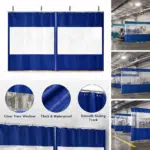
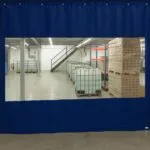
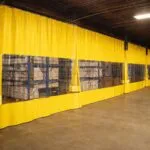
Curtain Projects With Fire-Rating Requirements
If fire-rating wording is part of the curtain requirement, confirm the exact material and document scope before ordering.
- Industrial PVC Curtains for general custom curtain projects.
- Car Wash Curtains for wet bay curtain projects.
- Certifications for available document context.
- Request Quote Support for reviewing required standard, finished size, application, and document needs.