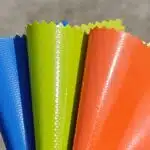
Comment choisir le tissu de base d'une bâche en PVC
Many buyers compare PVC tarpaulin by the most visible numbers:
- GSM
- épaisseur
- coating feel
But the internal base fabric is one of the biggest reasons two materials with similar top-line specs can perform very differently.
This page answers one narrow question only:
how does the base fabric affect PVC tarpaulin performance?
It is not the full buyer guide, and it is not the thickness chart page.
If you need the broader material-selection framework, see the Guide d'achat des bâches en PVC. If you need thickness and unit logic, use the Guide des épaisseurs de bâches en PVC.
Why Base Fabric Matters
PVC tarpaulin is not just a PVC surface. It combines:
- a polyester base fabric
- the PVC coating or laminated layer
The PVC layer contributes waterproofing and surface-facing performance. The base fabric contributes much of the structural behavior that affects:
- pulling strength
- tear spread
- stabilité dimensionnelle
- repeated stress handling
This is why gsm alone is not enough to explain how a tarpaulin will behave in real use.
Denier And Yarn Strength
Denier is one of the most common base-fabric terms buyers will see.
At a simple level:
- denier refers to yarn thickness
- higher denier generally means thicker and stronger yarn
Current SKP content already uses examples such as:
500D1000D
The practical meaning for buyers is straightforward:
- lower denier is usually more relevant to lighter-duty applications
- higher denier becomes more relevant when the material needs to tolerate greater load or tougher use
Denier still should not be read alone. It must be considered with weave and total material build.
Weave And Fabric Structure
Denier describes the yarn. Weave describes how that yarn is organized inside the tarpaulin.
Current SKP content already introduces:
- thread count
- weave density
- structure examples such as
1000D 20×20
Pourquoi c'est important :
- denser weave can help distribute stress across more fibers
- stronger weave can support better dimensional stability
- fabric structure changes how the sheet behaves when pulled, flexed, or tensioned
For buyers, the simplest reading is:
- denier helps describe yarn strength
- weave helps describe how that strength is built into the material
Fabric-To-PVC Ratio
Another useful concept from current SKP content is the relationship between:
- internal fabric strength
- PVC coating mass
Two materials can show similar GSM and still behave differently because the build balance is different.
If the internal fabric is weak, a heavier coating alone does not automatically create better real-world performance. If the internal fabric is stronger, the material may handle load and stress better even when the headline numbers seem similar.
That is one of the clearest reasons not to choose only by gsm or thickness.
When Stronger Base Fabric Matters Most
Base fabric matters more when the tarpaulin will face:
- repeated tension
- wind movement
- abrasion
- repeated folding
- edge stress
- longer-term outdoor use under mechanical load
This becomes more important in applications such as:
- transport covers
- systèmes de bâches pour remorques
- truck-side-curtain material
- tougher industrial protection jobs
If your real question is whether the overall material needs to move into a tougher-use class, see the Guide des bâches en PVC haute résistance.
What This Guide Covers
This guide explains base-fabric logic. Full material selection also depends on coating, weight, thickness, finishing, and application.
It does not replace:
- the full buying framework
- the thickness and gsm chart
- the PVC tarpaulin material and manufacturer information
Related selection references:
- Need broad selection help? Use the Guide d'achat des bâches en PVC.
- Need thickness and unit guidance? Use the Guide des épaisseurs de bâches en PVC.
- Vous avez besoin d'informations sur le matériau et le fabricant de la bâche en PVC ? Consultez Bâche en PVC.
Lectures complémentaires
- Guide d'achat des bâches en PVC for the full selection framework
- Guide des épaisseurs de bâches en PVC for gsm and thickness comparison
- Guide des bâches en PVC haute résistance for tougher-use selection logic
- Bâche en PVC pour les informations sur le matériau de la bâche en PVC et le fabricant
Related PVC Tarpaulin Options
These SKP pages connect base-fabric selection to SKP material supply and finished custom fabrication.
- matériau de bâche en PVC pour la sélection des matériaux et les capacités du fabricant.
- Rouleaux de bâche en PVC for roll-based supply and trimming options.
- fabrication sur mesure de bâches en PVC pour les fabricants d'équipement d'origine (OEM) for custom sizing, welding, printing, hemming, eyelets, and finished goods.